Global Container Gateway
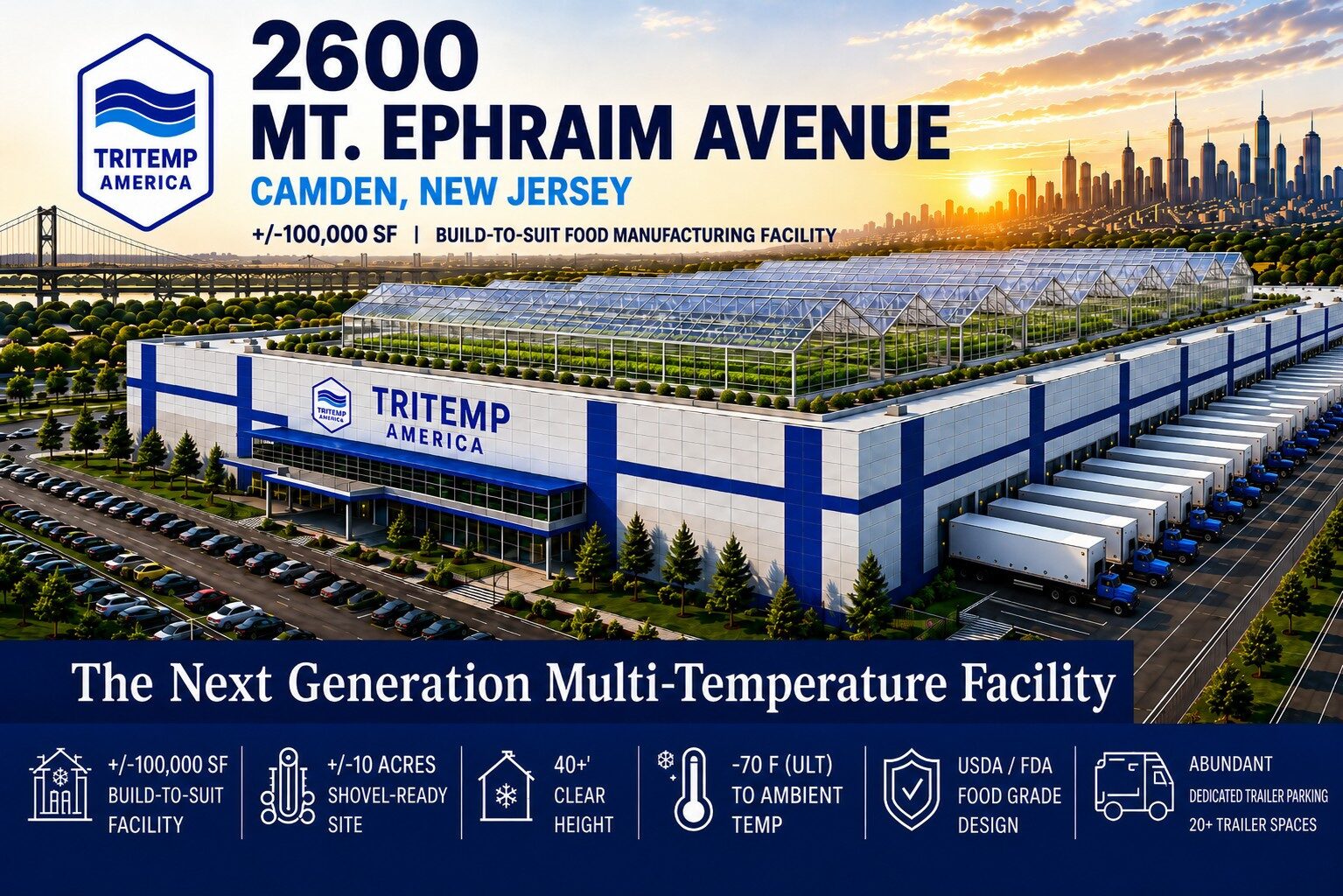
The Next Generation Multi-Temperature Food & Cold Chain Facility
Built for the Future of Food Manufacturing, Cold Storage & Distribution
The future of food logistics is no longer simply about warehouse space.
Today’s food manufacturers, importers, distributors, and cold-chain operators require facilities that can respond to multiple temperature environments, increasingly sophisticated food-safety standards, automation, energy efficiency, environmental friendly infrastructure, changing consumer demand, and rapidly evolving supply chains.
Global Container Gateway in Camden, New Jersey is being conceived around that future.
Strategically positioned in the heart of the Northeast Corridor, the project is planned as an approximately 100,000-square-foot build-to-suit multi-temperature food manufacturing and logistics facility, capable of supporting operations ranging from frozen and refrigerated storage to temperature-controlled food processing, packaging, distribution, and potentially multiple tenants within a single integrated platform.
Rather than designing a conventional refrigerated warehouse and adapting it later, Global Container Gateway is envisioned from the beginning as purpose-built food infrastructure.
One Facility. Multiple Temperature Environments. Multiple Possibilities.
The building concept combines multiple operating environments under one roof.
The planned platform can accommodate:
- Ultra-low-temperature and frozen storage
- Refrigerated / chilled storage
- Temperature-controlled processing
- Ambient warehouse and distribution
- Food manufacturing and packaging
- Import and export logistics
- Potential multi-tenant configurations
- Future expansion as customer requirements grow
The projected operating temperatures ranging approximately from -70°F through ambient conditions, with dedicated freezer, cold-storage, processing, receiving and shipping areas.
This flexibility is particularly important for food companies whose businesses rarely fit into a single temperature category.
A manufacturer may receive frozen ingredients, process products in a controlled environment, refrigerate finished goods, and distribute them throughout the Northeast—all within one coordinated facility.
That is the underlying idea behind the Next Generation Multi-Temperature Facility.
Designed Around the Food Supply Chain
Unlike a generic industrial building, Global Container Gateway is envisioned around the operating requirements of food businesses.
The building concept incorporates features such as approximately 40'+ clear height, insulated wall and roof systems, heavy floor loading, centralized refrigeration infrastructure, high-capacity utilities, truck circulation, shipping docks, food-grade environments, security systems and future automation capability.
The centralized refrigeration concept is particularly important.
Instead of treating each refrigerated room as an isolated system, the proposed infrastructure is designed to support multiple temperature zones through a coordinated refrigeration platform serving freezer, cold-storage and processing environments.
The brochure also emphasizes energy-efficient equipment, redundancy options, monitoring and controls, and a design philosophy focused on reliability, operating efficiency and food safety.
For an operator, that means the facility is being considered not simply in terms of construction cost, but also in terms of long-term operating performance.
At the Center of the Northeast Food Economy
Location is one of the most important components of the Global Container Gateway strategy.
Camden places the project within the Philadelphia metropolitan market and provides access to the broader I-95 Northeast Corridor, including Philadelphia, New York, Baltimore and Washington, D.C.
This allows the facility to function not merely as a local warehouse, but potentially as a regional distribution platform serving one of the largest concentrations of consumers and food businesses in North America.
For companies importing food products or ingredients, the location also creates an important connection to the Port of Philadelphia, a major refrigerated and perishables gateway, while providing reasonable access to the Port of New York/New Jersey and the broader international container network.
The result is a location where several supply-chain functions can converge:
Import → Storage → Processing → Packaging → Distribution
That combination is what differentiates Global Container Gateway from a conventional cold-storage development.
From Port to Production to Consumer
The project is intended to create a more efficient relationship between transportation infrastructure and food production.
Imported food products and ingredients arriving through East Coast ports can move into temperature-controlled storage, manufacturing or processing environments and then be distributed throughout the Northeast marketplace.
Domestic food producers can similarly use the facility as a manufacturing and distribution base serving regional customers.
For companies facing increasingly complicated logistics networks, this type of integrated facility can reduce unnecessary product movement while improving supply-chain visibility and operational control.
In simple terms:
Bring the supply chain closer together.
That is one of the central ideas behind Global Container Gateway.
Build-to-Suit Around the Operator
One of the most important messages for the website should be that this is not a speculative one-size-fits-all cold-storage warehouse.
The project is envisioned as a Build-to-Suit platform.
Food manufacturing and cold-chain facilities are highly specialized. Different operations require different refrigeration loads, sanitation systems, utilities, equipment layouts, ceiling heights, dock configurations, processing rooms and food-safety controls.
Global Container Gateway is therefore intended to be developed around the operational requirements of its users.
Depending on the tenant or operating model, the facility could potentially support:
Food Manufacturing
Cold Storage
Frozen Distribution
Fresh & Perishable Products
Protein
Seafood
Produce
Dairy
Beverage
Prepared Foods
Imported Foods
Food Ingredients
E-Commerce Grocery
Third-Party Cold Chain Logistics
This approach transforms the real estate development process from:
“Here is our building. Can your operation fit inside it?”
into:
“Tell us how your operation works, and we will design the facility around it.”
That is a much stronger message for sophisticated food-sector users.
Built for Change
Food supply chains are changing rapidly.
Automation is increasing.
Food-safety requirements continue to evolve.
Energy costs matter more.
Labor availability influences facility design.
Consumers increasingly expect fresher products and faster delivery.
Manufacturers need buildings capable of adapting as production lines, packaging formats and distribution networks change.
For these reasons, Global Container Gateway should be marketed not simply as a building for today's requirements, but as infrastructure designed for tomorrow's food industry.
The approximately 40'+ clear-height concept, centralized refrigeration infrastructure, heavy utilities and expansion capability described in the current development concept are intended to provide that long-term flexibility.